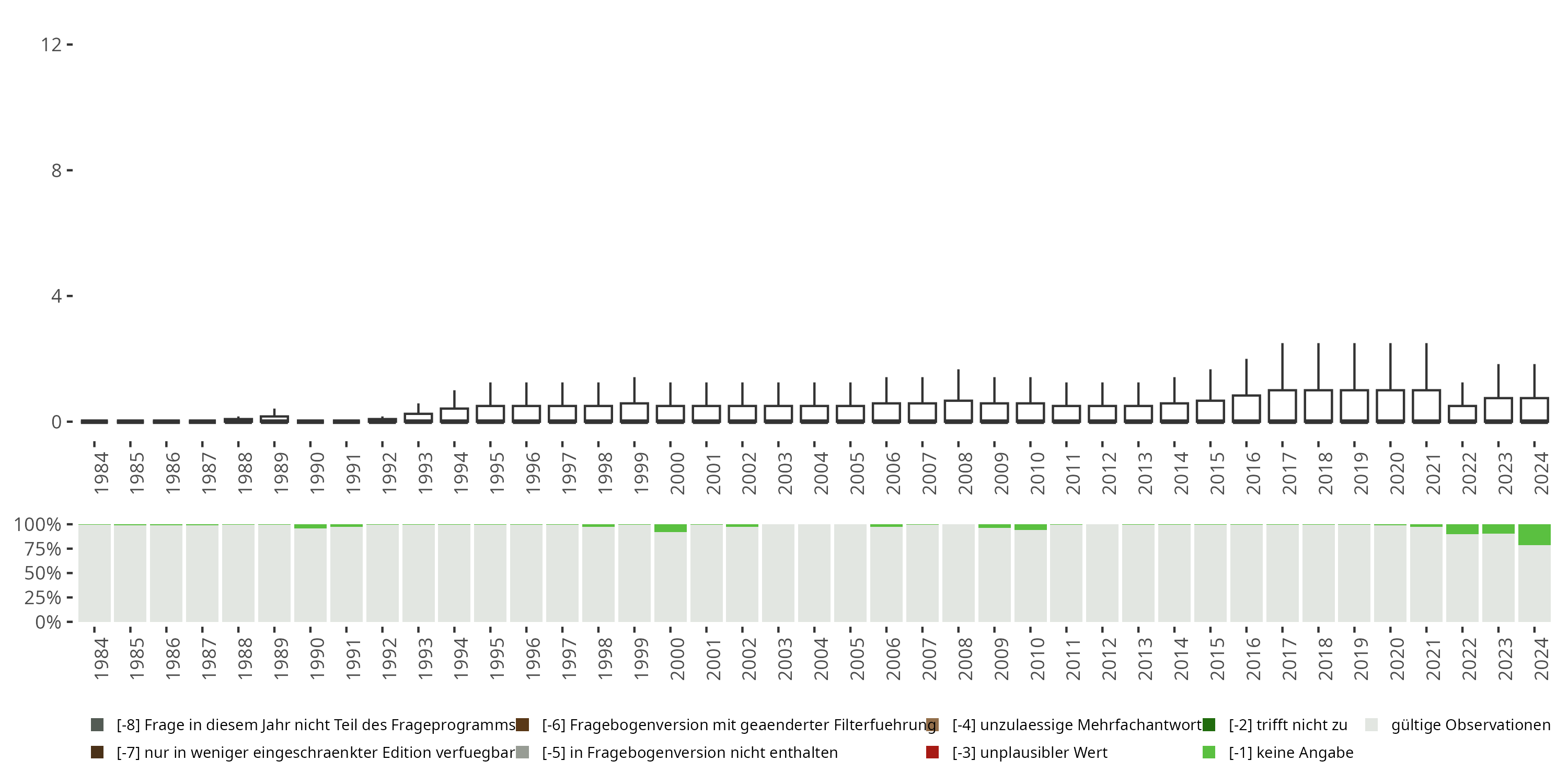
This variable reflects the total length of unemployment in the respondent's career up to the point of the interview in a given year. The variable is created by combining monthly information on employment status from the calendar dataset artkalen.dta, which provides monthly information on activity status since an individual entered the SOEP, and annual information from the biographical dataset pbiospe.dta, which provides information on activity status over the individual's life course. PGEXPUE is generated by adding up the years of unemployment before a respondent's first interview (from pbiospe.dta) plus the months of unemployment after their first interview (from artkalen.dta). If there is no monthly calendar data available in a given year of a respondent's career, the annual data from pbiospe.dta is used for that year. For annual data, if the year in which a spell started and ended is the same, a spell of 0.5 years is assumed. PGEXPUE gives the length of time in unemployment in years with months in decimal form.
Individuals without annual data (not contained in pbiospe.dta) are only assigned a non-missing value for this variable if they joined SOEP by the age of 18 and if there is calendar data on them in artkalen.dta. Respondents whose life course has been observed completely but with no spell of unemployment are assigned the code [0]. The code [-1] “No answer” is assigned to all people whose life course has not been observed completely. People with inconsistent information receive [-3] “Not valid”.
PGEXPUE gives the length of unemployment in years with months in decimal form. This means that a person who was unemployed for 2 years and 6 months, has a PGEXPUE value of 2.5 years.
Please also see pgexpft (total length of full-time employment) and pgexppt (total length of part-time employment).
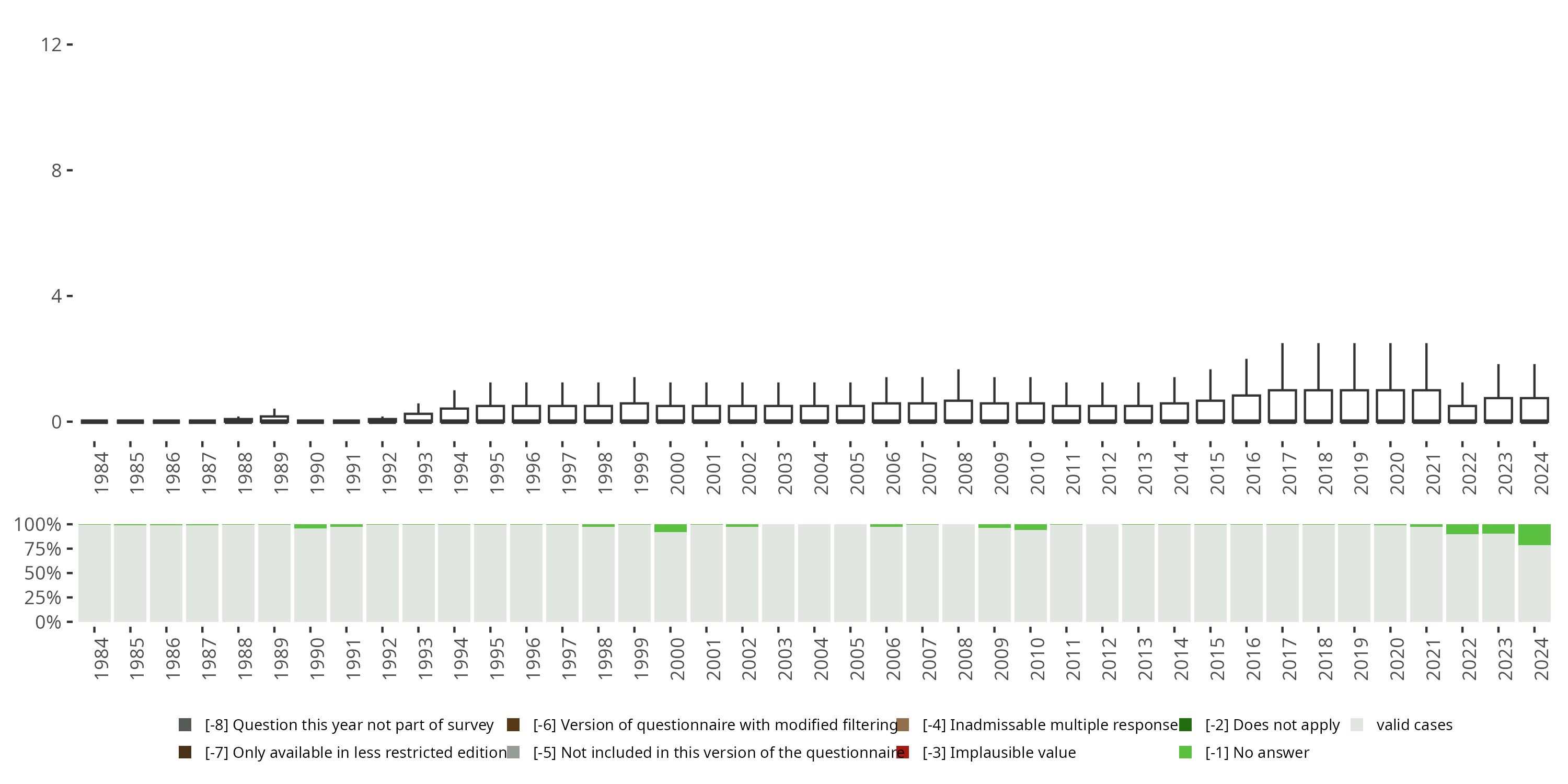
This variable reflects the total length of unemployment in the respondent's career up to the point of the interview in a given year. The variable is created by combining monthly information on employment status from the calendar dataset artkalen.dta, which provides monthly information on activity status since an individual entered the SOEP, and annual information from the biographical dataset pbiospe.dta, which provides information on activity status over the individual's life course. PGEXPUE is generated by adding up the years of unemployment before a respondent's first interview (from pbiospe.dta) plus the months of unemployment after their first interview (from artkalen.dta). If there is no monthly calendar data available in a given year of a respondent's career, the annual data from pbiospe.dta is used for that year. For annual data, if the year in which a spell started and ended is the same, a spell of 0.5 years is assumed. PGEXPUE gives the length of time in unemployment in years with months in decimal form.
Individuals without annual data (not contained in pbiospe.dta) are only assigned a non-missing value for this variable if they joined SOEP by the age of 18 and if there is calendar data on them in artkalen.dta. Respondents whose life course has been observed completely but with no spell of unemployment are assigned the code [0]. The code [-1] “No answer” is assigned to all people whose life course has not been observed completely. People with inconsistent information receive [-3] “Not valid”.
PGEXPUE gives the length of unemployment in years with months in decimal form. This means that a person who was unemployed for 2 years and 6 months, has a PGEXPUE value of 2.5 years.
Please also see pgexpft (total length of full-time employment) and pgexppt (total length of part-time employment).